


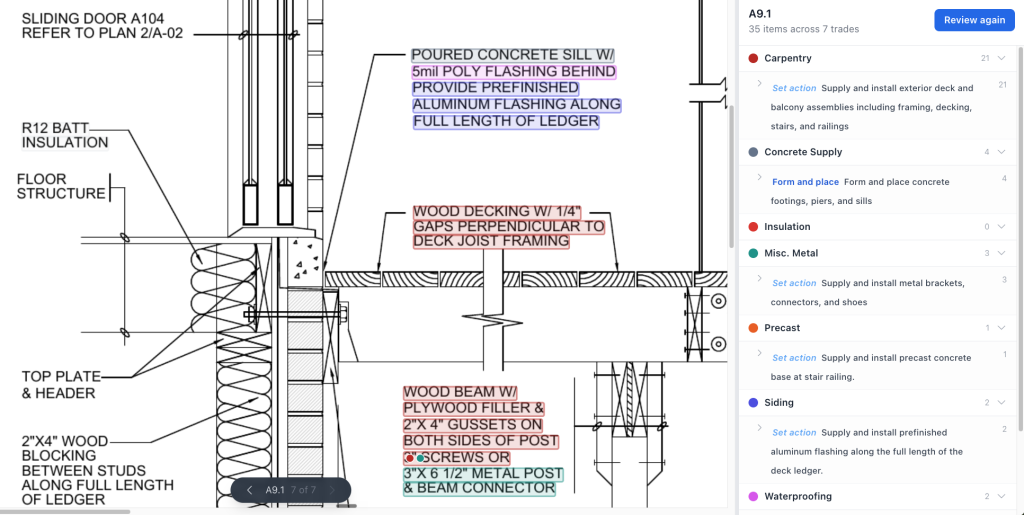
Provision, the Toronto-based startup that builds AI tools for construction preconstruction and bid teams, this week launched Scope Agent, a tool that reads drawings and specs, and produces a traceable scope of work: the line by line list of what a subcontractor is actually responsible for building.
To make its case, the company didn’t just publish an accuracy number, but ran its own model head to head against Anthropic’s Claude on plumbing scope extraction from a live hospital project, then published the results.
Scope Agent pulled 145 scope items at 91.7% verified accuracy; Claude extracted 96 items at 72.9%, with 18 of its 26 flagged errors traced to invented drawing marks, model numbers, or schedule entries that didn’t exist in the source material. Scope Agent, per Provision’s report, fabricated nothing.
“A 97% accurate scope sheet with full traceability is a document you can put in front of a subcontractor,” said Luigi La Corte, Provision’s CEO and founder, “a 73% accurate scope sheet with fabricated model numbers is a liability.”
The company also says Scope Agent has already been used on live tenders with some of the largest general contractors in Canada, including EllisDon, which used its output to issue a formal addendum in the New Brunswick Museum project. Provision calls it the first documented case of AI-generated scope flowing directly into a bid package at a top-tier GC.
On the U.S. side, California-based ProWest Constructors reports cutting the time from contract award to fully issued subcontracts in half since adopting the tool, and says it caught several sheet metal items its own senior estimator had missed on a Santa Barbara county job.
“It saved him three or four days on a project that size, and we noticed four or five items we had missed,” said Michael DeMarie, ProWest’s president, of the Santa Barbara job. “It was good enough for me to say, okay, we’re going to incorporate this.”
The launch comes at a moment when the underlying problem it’s chasing has gotten measurably worse.
The gap it’s selling into
Contractor revenue is climbing faster than the people who plan the work. ENR’s Top 400 list put contractor revenue up 11.8% in 2025, largely on data center construction, while estimating headcount hasn’t kept pace. That mismatch shows up first as missed or ambiguous scope, which the Construction Industry Institute has long pegged as a leading driver of rework, with direct costs it estimates at $15 billion a year industry-wide in the U.S.
“This is one of the highest-risk activities if you’re a bidding GC. If you don’t get it right, it stays with you from the day you start the job to the day you finish,” DeMarie stressed.
Provision’s own validation data puts a number on the manual alternative, too: the company says a professional estimator working to a fixed time budget hit 91.3% accuracy on the same kind of scope sheet, and took roughly four days per project to get there. Scope Agent, Provision says, returns a first pass in a fraction of that time.
Layer on a labor market that isn’t cooperating. The Associated Builders and Contractors (ABC) predicts the industry needs to attract roughly 349,000 net new workers in 2026 alone just to keep supply and demand in rough balance, a number ABC’s chief economist expects to climb toward 456,000 in 2027 as delayed projects come back online.
What’s more: a fifth of the existing construction workforce is nearing retirement. And that’s exactly the population, senior estimators, that scope extraction tools are pitching themselves as insurance against.
Contractors already seem to be leaning into automation as a release valve. ServiceTitan’s 2026 Commercial Specialty Contractor Industry Report, for one, found that 38% of contractors now see measurable results from AI, up from 17% in 2025, with cost estimating and bid management among the most common applications. Meanwhile, AGC’s 2026 hiring outlook puts the estimating specific number at closer to a quarter of firms.
Money is following the same signal. ConTech investment hit $1.031 billion across 84 transactions in Q2 2026 alone, a 30% jump over the prior year, according to Cemex Ventures, and roughly 70% of those deals involved AI native startups.
Here, preconstruction and estimating tools specifically have become one of the more active corners of that market this year, as venture investors bet that document-heavy, judgment-driven workflows like scoping are ripe for automation.
The Claude comparison, in context
The more interesting number for outside observers might not be Provision’s 97% internal accuracy figure; vendor run validation tests are, definitionally, a vendor’s best day. Rather, the fabrication rate it’s attributing to Claude on a narrow, document grounded extraction task.
It’s a plausible failure mode: independent 2026 hallucination benchmarking has found that general purpose frontier models run without retrieval grounding against source documents, error at rates anywhere from roughly 3% to 19% depending on task type. And a Deloitte survey also found 47% of enterprise AI users had made at least one major business decision based on hallucinated output.
“The value of Scope Agent is that it catches what a tired estimator will miss at 11 p.m. the night before a bid closes,” La Corte said.
Provision’s bet, however, is that a purpose built tool beats a general purpose model at a narrow, high stakes task. And it’s staking that claim on a specific number: a nearly 19-point accuracy gap over Claude on a real project.
Whether that gap holds up on other drawing sets, other trades, and other reviewers is a separate question, but the launch lands squarely in the middle of the pressure construction firms are already under, rising revenue outpacing estimating capacity, a labor shortage projected to run into the hundreds of thousands of workers, and a growing share of contractors reporting that AI is starting to earn its place in the bid process.
That combination is likely to keep scope extraction, and the accuracy claims vendors make about it, a live topic through the rest of 2026.
Featured image: Evgeniy Surzhan via Unsplash+
Disclosure: This article mentions a client of an Espacio portfolio company.