

In January 2026, staff at the VA Augusta Health Care System in Georgia began calling veterans to cancel their surgeries. The hospital’s main operating room had closed for the fourth time in five months.
The cause was supplies: incomplete kits, expired materials and unreliable restocking forced the closures, according to a September report from the VA Office of Inspector General. One shutdown lasted 27 days.
Inspectors found that the secondary supply room near the surgical suites was so unreliable that staff had to make urgent calls to the main storeroom during operations. An operating room leader told them the closures led to surgical backlogs, cancellations and delays.
The VA had already spent $3.2 million in 2021 on an automated inventory system purposed with preventing this kind of failure, though it had only been partly installed and was switched off in 2023. The technology was there, but it never connected with the way the hospital actually worked.
The problems were serious enough that the VA Secretary visited the facility in March this year and raised concerns about its supply chain. By then, the report notes, clinicians had grown to distrust the hospital’s supply operations altogether.
Most discussion of AI in healthcare focuses on diagnoses, medical imaging and clinical assistants. While those are major advancements, Augusta points to a less visible part of the system, the work of getting the right product to the right room on time, where AI could make a real difference.
That is the problem Adrián Figueroa built his company around. His platform, Routina, applies AI to the coordination between medical product distributors and the organizations they supply, and it is about to get its first major test in the Caribbean.
Why buying technology wasn’t enough
The inspectors’ findings show how wide the gap between tools and practice had become. Of 100 supply items they checked, records matched what was on the shelves for only 11.
Staff kept handwritten logs instead of scanning barcodes, and just 60 of 125 authorized supply chain positions were filled, leaving employees to cover several roles at once.
The automated system’s cabinets and equipment were found abandoned in a warehouse. A second contract worth about $223,000, signed in December 2025, was supposed to finish the installation by May 2026. By June, it still wasn’t done.
Augusta was an extreme case, but not a unique one. A 2024 OIG review found VA facilities out of compliance with supply chain policy in about 18.5% of the areas regional reviewers checked.
Research on administrative AI points the same way. In April, the Peterson Health Technology Institute reported that AI applied to flawed workflows tends to amplify their problems, and that processes need redesigning before the technology can pay off.
Scattered data and manual fixes
A single medical supply passes through distributors, pharmacies, clinics and laboratories. Each runs its own systems, spreadsheets, emails and phone calls.
The information exists, but it is scattered. People end up reconciling it by hand, which costs time, creates errors and drives up costs in an industry where precision isn’t optional.
The burden is substantial. A study in the Annals of Internal Medicine found administration made up 34.2% of U.S. national health spending in 2017, about $812 billion. That figure covers more than logistics, including insurer overhead and billing.
The potential savings are large as well: researchers from McKinsey and Harvard estimated in an NBER working paper that wider AI adoption could cut U.S. healthcare spending by 5% to 10%, or $200 billion to $360 billion a year in 2019 dollars.
Figueroa has spent years on this problem. An electrical engineer and Stanford Graduate School of Business graduate, he sold his first company, a food delivery business, in 2015. He then founded Flexio, a technology-enabled services company focused on healthcare logistics and in 2024, launched Routina, a platform that uses software and AI to help medical product distributors and other health organizations connect information across their systems and cut manual coordination.
Figueroa says the challenge goes beyond adding AI; every player’s data and processes have to work together, and automations should give teams more information and capacity while leaving them in charge.
Who watches the machine?
In health care operations, mistakes have consequences, so the question is unavoidable. Figueroa argues that a person alone can’t review everything.
“In today’s AI world, the volume of outputs is more than a human can process. Reviewing everything makes the human the bottleneck, but human judgment is still necessary for high-risk or low-confidence decisions,” he said.
Routina’s AI assigns each output a confidence level and a risk level; only low-confidence or high-risk results go to a person for approval.
The review does have to be real, though. “Human oversight has to be real, not a person clicking ‘approve’ all day. Specific people own those flagged decisions; they have the authority to override the system, and every override is recorded and reviewed,” he added.
That’s not just good practice. Article 14 of the EU AI Act requires high-risk systems to allow effective human oversight, including the ability to override them and awareness and of the tendency to over-rely on their outputs.
Though those rules are not yet in force, with the EU’s Digital Omnibus on AI delaying them to December 2027 for stand-alone systems and August 2028 for AI in regulated products, a supply chain coordination platform may still fall outside the high-risk categories entirely as the article remains a useful benchmark.
Figueroa adds two principles: transparency, whereby people need to know what’s being measured and why, with the metrics reviewed regularly; and accountability. “What AI shouldn’t do is make the final call.”
A concrete case in the Dominican Republic
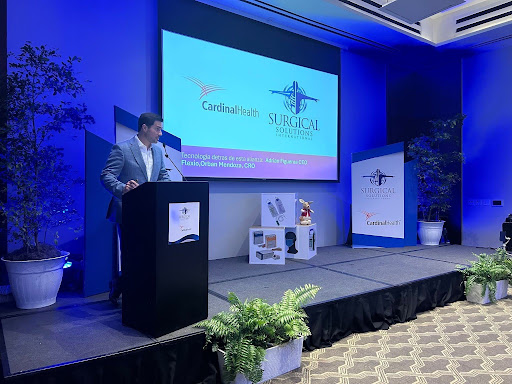
Routina’s approach now faces its first major test. In September, Surgical Solutions International and Cardinal Health introduced a new line of medical products in the Dominican Republic as part of a strategic alliance.
“We will be implementing Routina’s technology at Surgical Solutions for the handling of all Cardinal Health products and future suppliers,” Figueroa explained.
He also plans to present Routina directly to Cardinal Health “as a solution to manage all of its distributors in the different countries where people operate.”
The rollout will show whether confidence and risk scoring holds up across a multinational supplier’s full catalog, and may also give Figueroa the case study he needs before pitching Cardinal itself.
The conversation about AI in health care can’t stop at the exam room, however. Behind every patient treated is a chain of logistics decisions that has to run with precision, and the organizations that coordinate it best, with AI that extends their teams and people who keep the last word, will be the ones that deliver a more efficient and reliable system.
Featured image: courtesy of Routina

Disclosure: This article mentions a client of an Espacio portfolio company